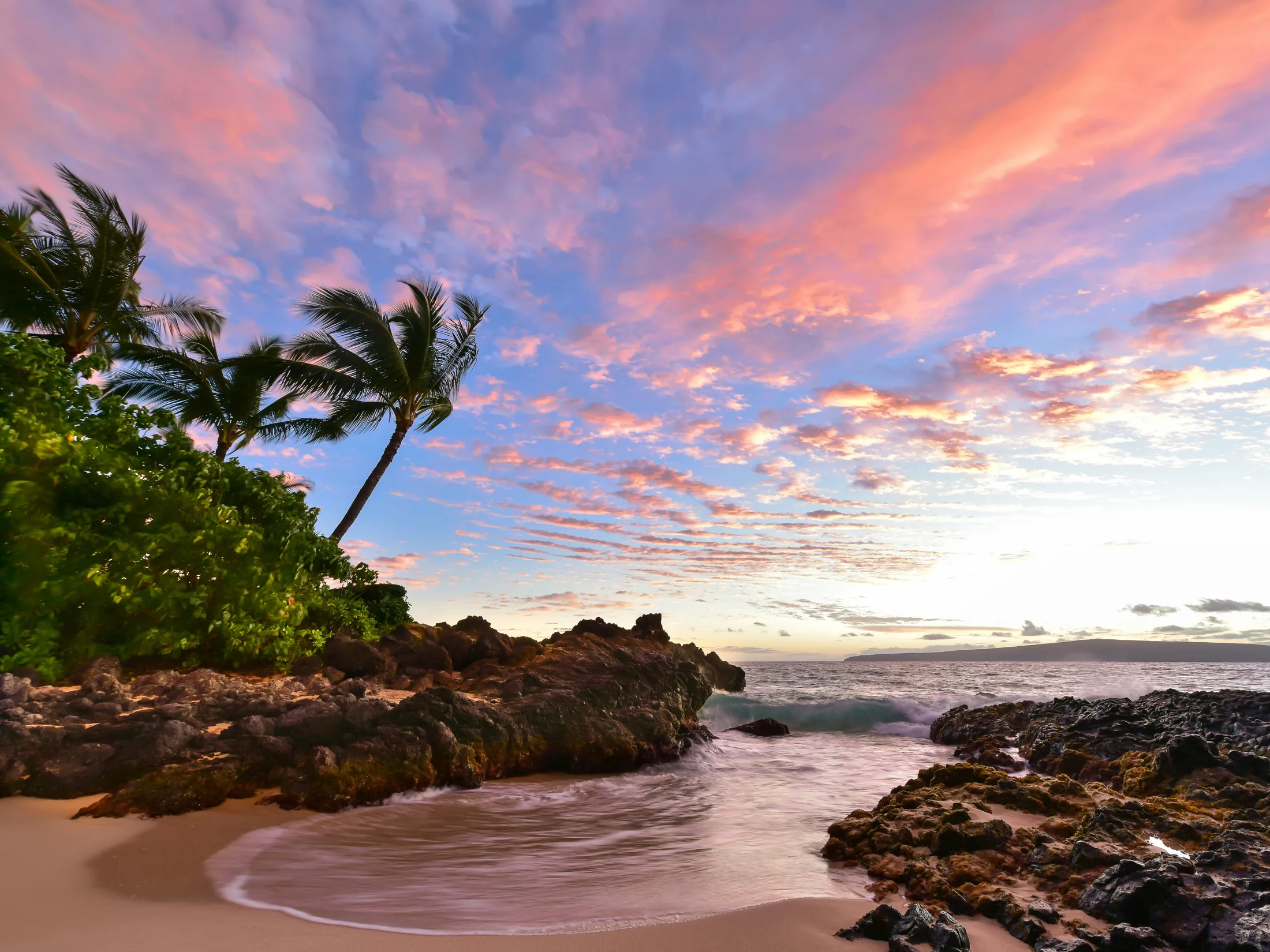


Maui is generous to people who don’t chase the moment too hard.
The best wildlife watching here often happens from places that already give animals room: a whale seen from a roadside lookout above Māʻalaea Bay, a nēnē stepping through the grass in the cool air of Haleakalā, aeʻo picking through the shallows at Keālia Pond, honu resting where the sand meets the rocks.
That is the sweet spot for wildlife viewing on Maui: choose settings where distance is built in, bring a little patience, and let the island do what it does without trying to turn every animal into a close-up.
Start with Maui’s strongest wildlife season: humpback whales
If you visit Maui in winter, whales may shape the whole trip. Humpback whales come to Hawaiʻi’s warm waters seasonally to breed, give birth, and nurse their calves, and the shallow channels around Maui Nui are among the best places in the state to watch from shore.
You do not need to be on a boat to have a good whale day. Some of the most satisfying viewing is land-based: coffee in hand, binoculars up, scanning the water for spouts, tail slaps, and the long white flash of pectoral fins below the surface.
Papawai Point and the Māʻalaea coastline
The stretch between Māʻalaea and West Maui is one of Maui’s classic whale-watching corridors. Papawai Point gives you elevation, open water, and a natural pause in the drive. On a clear winter morning, the scene can feel almost theatrical: boats below, Lānaʻi and Kahoʻolawe in the distance, and whales surfacing across the channel.
It is also a good example of viewing made easy. You are on land, the whales are offshore, and the experience depends on observation rather than approach. Bring binoculars if you have them. Without them, watch for spouts first; once you learn the rhythm, your eyes will start catching more.
South and West Maui shorelines
Kīhei, Wailea, Kā‘anapali, Nāpili, and Kapalua all have stretches of coast where whale watching becomes part of the day rather than a separate activity. You may be walking a shoreline path, sitting at a beach park, or eating breakfast with one eye on the horizon.
The tradeoff is that these are also busy visitor areas. For a more relaxed experience, look for places where you can sit above the water or slightly back from the main beach traffic. Whales are easier to appreciate when you are not trying to watch them through umbrellas, swimmers, and selfie poses.
Choosing a whale-watching boat
A well-run whale watch can be excellent on Maui. Choose an operator whose whole style feels unhurried: naturalist interpretation, respectful approach behavior, and no promise that the boat will “get you close.” The best captains understand that a whale deciding to surface nearby is very different from a boat pressing into an animal’s space.
If you are prone to seasickness or traveling with young kids, a shorter trip from a convenient harbor may be better than the most ambitious itinerary. Wildlife viewing is easier when everyone on board is comfortable enough to listen, look, and enjoy the water without needing the trip to become a spectacle.
Honu on Maui: watch the resting places, not the crowd
Green sea turtles, often called honu, are one of the animals visitors most hope to see on Maui. They feed along rocky shorelines, surface in shallow water, and sometimes rest on beaches. A turtle on the sand is not “posing”; it is recovering energy.
Hoʻokipa Beach Park, on Maui’s North Shore near Pāʻia, is one of the better-known places where turtles may haul out. It can also be crowded, windy, full of surf energy, and busy with people who arrived for very different reasons: surfers, windsurfers, photographers, families, and visitors hoping to see honu.
The most tasteful way to experience it is from the bluff or from well back on the sand, especially if turtles are resting near the beach edge. If volunteers or signage have created a viewing area, treat that as part of the place rather than an obstacle to your photo. The turtles are most interesting when you give them enough room to behave naturally.
South Maui’s lava-and-sand coastline also offers turtle sightings, especially around rocky margins where algae grows. Snorkelers sometimes encounter honu while exploring near reefs. The best approach is simple: do not follow them, do not hover over them, and do not try to frame the perfect underwater shot at the animal’s expense.
A turtle surfacing for air should have a clear path. If you give it one, the encounter feels better anyway—less like a pursuit, more like being lucky enough to share the water for a moment.
Monk seals are much less predictable on Maui than turtles. If you happen to see one resting on the sand, consider it a rare surprise. Stay well back, respect any temporary perimeter, and let the seal sleep. That is the whole experience.
Keālia Pond: Maui’s quiet birding lesson
Between Kīhei and Māʻalaea, Keālia Pond National Wildlife Refuge protects one of Maui’s important wetland habitats. It is not dramatic in the way people often expect Maui to be. There are no waterfalls, no cliffside reveal, no big cinematic entrance. Its beauty is flatter and subtler: shallow water, mudflats, grasses, birds moving with purpose.
That is exactly why it is worth your time.
Keālia is a good place to look for native and endangered Hawaiian waterbirds such as aeʻo, the Hawaiian stilt, and ʻalae keʻokeʻo, the Hawaiian coot. Depending on water levels and season, you may also see migratory shorebirds and other wetland species. Birding here rewards stillness. Walk slowly, use binoculars, and let your eyes adjust to small movement.
The boardwalk and designated viewing areas make this one of Maui’s easiest low-impact wildlife stops. You are not pushing into habitat; you are observing from the edge of it. It can be a satisfying pause between resort-side South Maui and the drive toward Māʻalaea or the airport, especially in the morning or late afternoon when the light is kinder.
Haleakalā: nēnē, forest birds, and the patience of elevation
Maui’s wildlife is not only along the coast. Haleakalā changes the scale of the island. The air cools, the plants shift, and the animals you notice are different: nēnē near open grassy areas, native honeycreepers moving through trees, and, in the higher reaches, protected habitats tied to some of Hawaiʻi’s rarest species.
Hosmer Grove, inside Haleakalā National Park, is one of the more approachable places to listen and look for forest birds. You may see or hear native honeycreepers such as ʻapapane, ʻamakihi, or ʻiʻiwi, though sightings vary with season, weather, and luck. This is not a zoo-style encounter. It is a forest walk where a flash of red or yellow-green can become the highlight of the morning.
Nēnē, Hawaiʻi’s state bird, are also seen in parts of the park and along upper-elevation roads. They can appear surprisingly calm around people and vehicles, which is exactly why visitors need to be calm around them. Do not feed them, do not crowd them, and be alert while driving. A nēnē standing near a roadside is still a wild bird, even if it looks unbothered by the world.
Haleakalā is also home to ʻuaʻu, the Hawaiian petrel, a seabird that nests in high-elevation volcanic terrain and returns under cover of darkness. Most visitors will not see one, and that is fine. Some wildlife is best appreciated by knowing it belongs there, not by trying to force an encounter.
Reefs, fish, and seabirds
Maui’s marine wildlife is not limited to charismatic animals with easy names. Reef fish, corals, urchins, eels, and seabirds are part of the island’s living coastline, and they can be just as memorable when you slow down enough to notice them.
The lava shoreline south of Wailea and Mākena offers some of Maui’s more interesting nearshore marine habitat, including areas associated with ʻĀhihi-Kīnaʻu Natural Area Reserve. The appeal here is the structure: clear pockets of water, lava fingers, reef life, and fish moving through channels that look plain from shore until you put your face in the water.
Use designated access points, avoid standing on coral or reef, and skip the water if conditions are rough or visibility is poor. Good snorkeling depends on calm movement. The less you flail, the more you see.
Molokini is often thought of as a snorkel destination, but it is also seabird habitat and part of Maui’s offshore wildlife story. A boat trip there can be worthwhile when conditions and crowds line up well, especially for travelers who are curious about both reef life and the geology of the crater. As with whale watching, the operator matters: a thoughtful crew will set expectations, explain conditions, and keep the experience focused on observation rather than conquest.
A simple way to plan wildlife viewing into a Maui trip
You do not need to build your entire itinerary around wildlife to have rich encounters. The better plan is to layer wildlife into the places you already want to be.
In winter, choose one or two shore-based whale-watching pauses and consider a boat trip if your group enjoys being on the water. In South Maui, pair Keālia Pond with a beach or lunch plan instead of treating it as an all-day outing. On a Haleakalā day, leave enough quiet time for Hosmer Grove or another short walk where birds—not the summit photo—can have your attention. If you snorkel, pick conditions and habitat over the most famous name.
Maui makes that possible in unusually beautiful ways. A whale spout beyond Māʻalaea. A turtle asleep at Hoʻokipa. A stilt stepping through Keālia’s shallows. A nēnē calling in the thin air of Haleakalā.
None of those moments need help from us to become memorable. They just need enough room to happen.

Further Reading
A few relevant next steps from Alakai Aloha.
 BlogMaui’s Native, Endemic, and Invasive Life
Learn the difference between native, endemic, introduced, and invasive species on Maui, with local examples and simple ways to protect the island as you explore.
Editor's pick GuideBest Beaches on Maui: Swimming, Snorkeling & Sunsets
A guide to best beaches on Maui.
Editor's pick ActivityHaleakalā National Park
Explore Haleakalā National Park, encompassing the dormant volcano's summit for breathtaking sunrises, sunsets, and stargazing, alongside the lush Kīpahulu District's waterfalls and pools.
Editor's pick ActivityKeālia Pond National Wildlife Refuge
Explore Keālia Pond National Wildlife Refuge, a critical wetland sanctuary on Maui, offering exceptional birdwatching, nature photography, and educational insights into endangered Hawaiian waterbirds and diverse migratory species.
Editor's pick