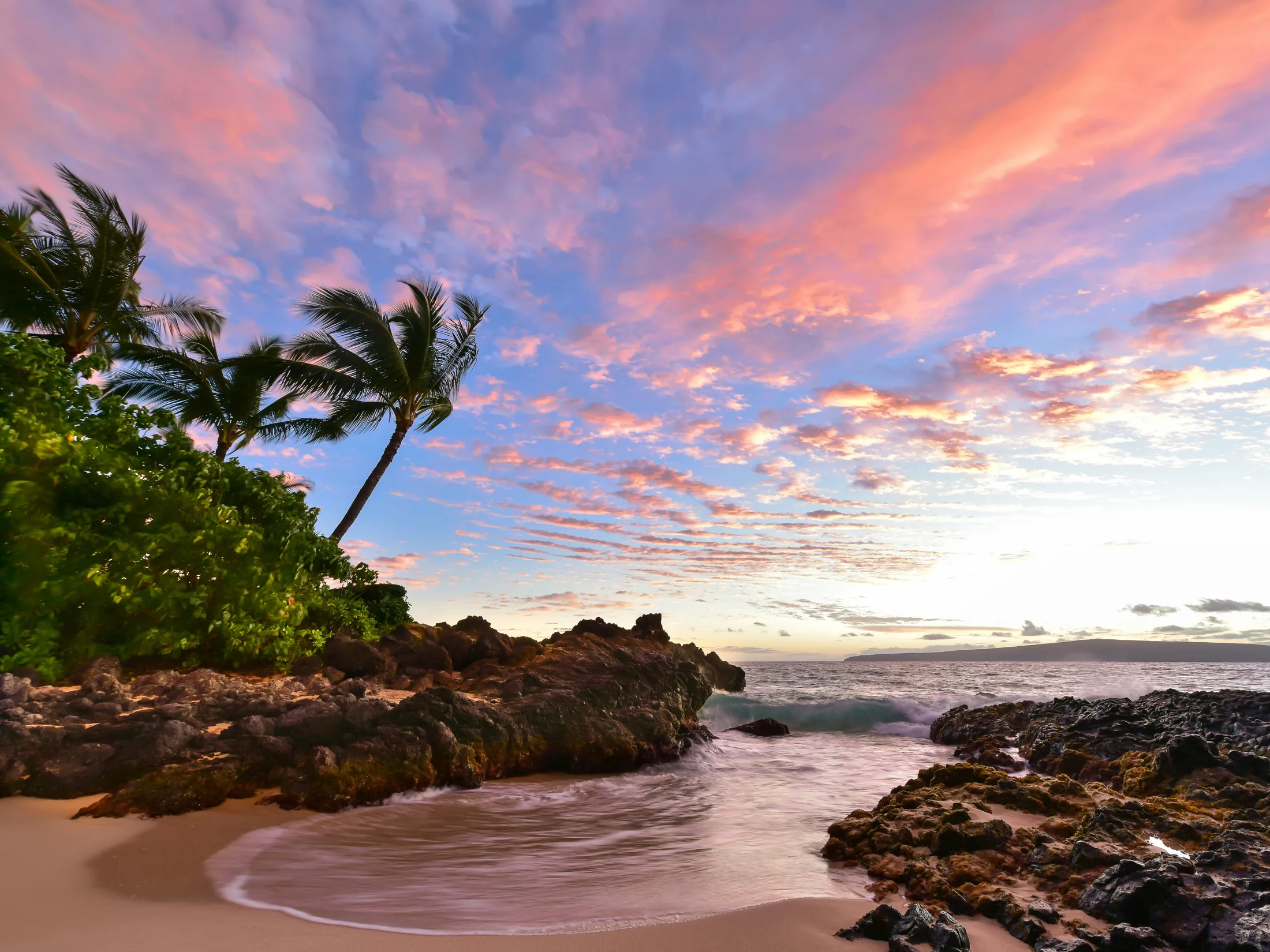


Every winter, Maui’s ocean changes character.
The same water you looked across in August and saw only wind lines may, in February, keep interrupting itself: a white puff on the horizon, a dark back rolling through the channel, a tail lifted cleanly before a dive. Sometimes the whole beach hears it before anyone sees it — that heavy, sudden slap of a pectoral fin hitting the surface.
These are koholā, humpback whales, returning to Hawaiʻi to breed, calve, and nurse after feeding in northern waters. Maui is one of the best places in the islands to watch them because of the broad, protected waters of Maui Nui — the ocean spaces between Maui, Lānaʻi, Molokaʻi, and Kahoʻolawe. In season, a good pair of eyes and a little patience can be enough.
When to see humpback whales on Maui
Maui’s whale season generally runs from late fall into spring. The first sightings may come in November, and a few whales may still be around in April, but the heart of the season is usually January through March. If whale watching is a major reason for your trip, February is often the sweet spot: plenty of activity, frequent mother-and-calf sightings, and a good chance of seeing behavior from shore.
Whales can be active at any time of day. Maui’s mornings often give you the cleanest viewing. Winds tend to build later, especially around Māʻalaea and the central valley, and a smoother ocean makes it easier to spot blows and backs. If you are prone to seasickness and planning a boat tour, a morning departure is usually the gentler bet.
A simple rhythm works well: look out during breakfast, keep binoculars in the car, and leave yourself time to stop at viewpoints rather than treating whale watching as a single appointment.
What you’re looking for
A humpback blow is often the first sign — a pale burst of mist rising and disappearing quickly. Once you see one, keep watching that patch of water. Whales often surface several times before diving, and groups may travel in a loose line.
Common behaviors around Maui include:
Blows: the easiest long-distance cue, especially in calm light Tail flukes: often seen before a deeper dive Pectoral fin slaps: long white fins repeatedly hitting the surface Tail slaps: louder, sharper impacts that can carry across the water Breaches: a whale launching part or all of its body out of the sea Spyhops: the head rising vertically, as if the whale is looking around
Not every outing is a spectacle, and that is part of the appeal. Some days you get quiet arcs and distant spouts. Other days the channel seems to be boiling with activity. Maui rewards the person who keeps looking.
The best shore viewing areas on Maui
Boat tours are popular, but shore-based whale watching on Maui is excellent. It is also wonderfully low-pressure: no schedule, no seasickness, no need to chase anything.
Papawai Point and the Pali coastline
The stretch between Māʻalaea and West Maui is one of Maui’s classic whale-watching corridors. The pullouts near Papawai Point and the Pali give wide views across the ʻAuʻau Channel toward Lānaʻi and Kahoʻolawe. In peak season, this can feel like a theater balcony over whale country.
Parking is limited and traffic moves quickly along Honoapiʻilani Highway, so make it a short, intentional stop rather than a casual swerve. Bring binoculars and a layer; it can be windy even on a sunny day.
Māʻalaea
Māʻalaea sits right at the edge of productive whale-watching water. If you are staying in Kīhei, Wailea, or central Maui, it is one of the easiest places to connect with the season, whether you are walking near the harbor area, joining a boat tour, or scanning the channel from nearby shoreline.
The afternoon wind here can be no joke, which is another reason mornings tend to be more pleasant.
Kīhei, Wailea, and Mākena
South Maui makes whale watching feel casual in the best way. From Kīhei’s beach parks and the Kamaʻole beaches, you can look out toward Kahoʻolawe, Molokini, and the open channel while staying close to cafés, condos, and family-friendly sand. Walk the beach in the morning, stop when you see a blow, and give yourself a few minutes. Many people look away too soon.
Farther south, the Wailea coastal walk, resort lawns, and beach access points give you room to pause and scan without scrambling over rough terrain. This is one of the better options for multigenerational groups: grandparents can sit, kids can move, and nobody has to stand on a cliff edge to participate.
Mākena opens the view even more. The coastline feels broader and less built-up, with long sightlines across whale habitat. On a clear winter morning, this area can be superb for slow watching: spouts far out, tail slaps closer in, and the occasional breach that makes everyone on the beach point at once.
Kāʻanapali, Nāpili, and Kapalua
West Maui also has strong whale-watching potential, with views toward Lānaʻi and Molokaʻi. From Kāʻanapali Beach, the Nāpili area, and the Kapalua coastal path, winter mornings can bring repeated sightings offshore.
This side is especially good if you are already staying in West Maui and want whales woven into the day rather than separated into a tour. Bring binoculars to breakfast or on a coastal walk and you may find yourself lingering longer than planned.
North Shore and East Maui
You can see whales from parts of the North Shore and along the road toward Hāna, but these are not usually the easiest whale-watching choices for a first-time visitor. Winter surf, wind, and road logistics can make viewing less relaxed. If whales are your goal, South and West Maui give you better odds with less effort.
Should you take a whale-watching boat tour?
If it fits your trip, yes — a good boat tour can be memorable. You will be lower to the water, you may hear whale song through a hydrophone, and naturalists can help you understand what you are seeing: competition pods, mother-and-calf behavior, escort males, resting patterns.
Most Maui whale-watch tours operate from areas such as Māʻalaea and West Maui, though exact departure points can vary. Confirm where your tour leaves from rather than assuming an old harbor routine still applies.
When choosing a tour, look less at promises of closeness and more at judgment. Good signs include:
Naturalists or trained crew on board A clear explanation of legal viewing distances A plan for what the vessel does if whales approach on their own A boat size that suits your group and comfort level Realistic language about wildlife, not guaranteed drama
Larger boats and catamarans tend to be steadier for families or anyone worried about motion. Smaller rafts can feel more intimate but may be wetter and bumpier. If you are not sure, choose comfort. The whales do not become less impressive because you saw them from a stable deck.
Kayak and paddle tours in South Maui sometimes encounter whales in season, but they are not the best choice for everyone. Human-powered craft require more awareness and less ability to reposition. Go with a reputable guide and understand that the goal is not to get close; it is to be present in the same winter ocean.
Give whales room
Humpback whales in Hawaiʻi are protected, and Maui’s waters are part of a larger sanctuary landscape created to support them. The practical rule for visitors is simple: do not approach, chase, touch, swim with, or try to position yourself in a whale’s path.
If you are on a licensed tour, the captain should manage viewing distance. If you are on a private boat, kayak, or paddleboard, know the current NOAA rules before you go out. From shore, it is easier: watch, enjoy, and let the whales move through their own season. If a whale surfaces close to the coast, that is luck — not an invitation to enter the water.
“Koholā” is the Hawaiian word commonly used for humpback whale. In Hawaiʻi, whales are not just scenery; they carry cultural meaning, family meaning, and conservation meaning. You do not need to perform anything special to honor that. Watch with attention. Give them room. Let the encounter be enough.
How to make the most of a Maui whale day
The best whale watching on Maui often happens in between plans.
Start early. Take coffee to the beach. Scan slowly from left to right, then rest your eyes and scan again. Look for blows, not bodies. If you spot one whale, assume there may be more nearby. If people are gathered quietly at a railing or overlook, they may be tracking activity you have not noticed yet.
Binoculars help enormously, even a small travel pair. A camera is nice, but whales are difficult subjects; many visitors spend the whole moment trying to catch the breach that already happened. Watch first. Photograph second.
And build in pauses. Maui in whale season is not just about seeing a humpback breach. It is about the way the island’s winter ocean holds your attention — how strangers on a beach briefly become a spotting team, how breakfast takes longer because someone saw a tail, how the channel between islands starts to feel alive in a new way.
If you are here between January and March, give the whales room in your itinerary. Not a packed expedition. Just room. The koholā usually take care of the rest.

Further Reading
A few relevant next steps from Alakai Aloha.
 BlogWhere to Watch Whales from Shore
Maui is unusually good for whale watching without stepping onto a boat. In winter, the water between Maui, Lānaʻi, Molokaʻi, and Kahoʻolawe becomes a broad stage for humpback whales, and much of the island’s west and...
Editor's pick GuideBest Maui Whale Watching Tours
A guide to Maui whale watching tours.
Editor's pick ActivityKaanapali Beach
Kaʻanapali Beach, a renowned three-mile stretch of white sand in West Maui, offers clear turquoise waters perfect for swimming, sunbathing, and snorkeling at Black Rock, plus a daily sunset cliff diving ceremony.
Editor's pick BlogMaui’s ʻIwa, the Bird That Rides the Wind
Learn how to spot Maui’s ʻiwa by silhouette, understand its wind-riding behavior and cultural meaning, and choose respectful places to watch from shore.
Editor's pick