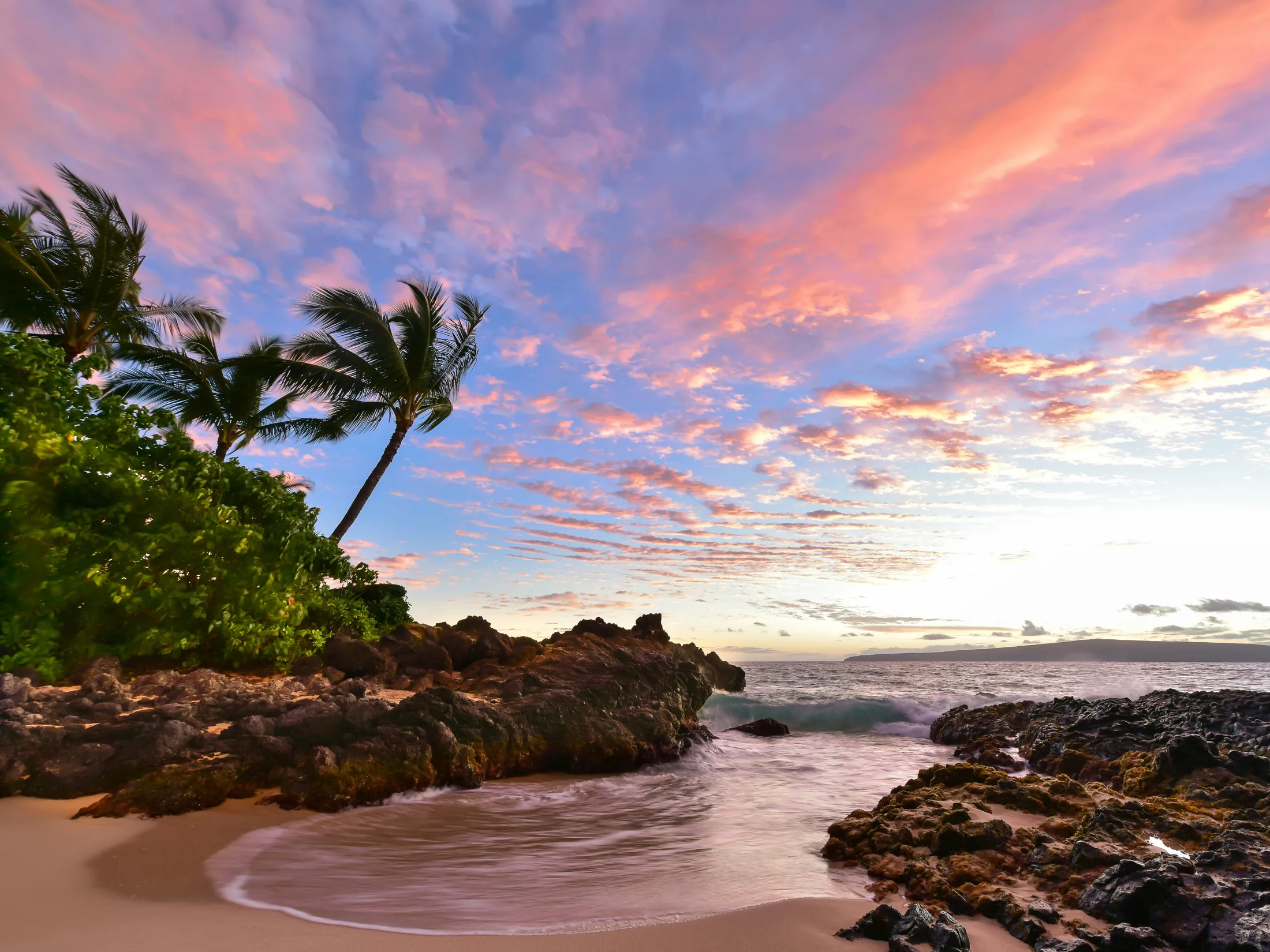


Maui’s quieter places are not usually “secret.” They are often public, loved, and perfectly findable — just a little less convenient than the beach in front of your hotel or the trail everyone saw on social media last week.
That inconvenience is part of the bargain. A cooler forest walk may mean driving upcountry. A more spacious beach may have no resort bar, no towel service, and no guarantee the ocean will be gentle. A lava-field trail may be unforgettable in the morning and punishing by noon.
The reward is a version of Maui that feels more textured: ironwood shade, red dirt, old lava, salt wind, jacaranda season upcountry, and beaches where the loudest sound is the shorebreak breathing in and out.
What “off the beaten path” means on Maui
On Maui, solitude is seasonal and conditional. A beach that feels empty on a weekday morning may be crowded at sunset. A trail that starts in clear weather can disappear into mist. A north or west shore cove that looks inviting in summer can become wave-washed and serious in winter.
So the better question is not “Where is the hidden spot?” It is: Where can I go legally, comfortably, and at the right time of day for the conditions?
A few useful Maui patterns:
Mornings are usually kinder for wind, heat, parking, and ocean texture. Winter brings larger north and west swells, which can make some beaches better for watching than swimming. South shore beaches can see summer swell, including stronger shorebreak on certain days. Upcountry and forest trails are cooler, but they can be muddy or misty. Remote does not always mean better. Sometimes the best choice is a known public beach at the quiet end, at the quiet hour.
Waihou Spring Trail: a cool upcountry reset
If your Maui trip has been all salt, sun, and sand, the Waihou Spring area in Olinda feels like stepping into a different island mood. The air is cooler. The light filters through forest. Instead of a dramatic summit or waterfall payoff, the pleasure is in the quiet rhythm of walking above the coast, with shade, glimpses, and the hush of upcountry Maui.
This is a good choice if you want a gentler hike without devoting a full day to Haleakalā or the Road to Hāna. Wear shoes you do not mind getting dusty or muddy, and bring a light layer if you are coming from the coast.
Kahakapao / Makawao Forest: shade, red dirt, and local rhythm
Makawao Forest is not a “stand at the overlook and take the photo” kind of place. It is more lived-in than that: runners, walkers, mountain bikers, families, dogs, and the smell of eucalyptus and damp earth after rain.
If you are used to coastal Maui, the forest can feel surprisingly cool and rooted — a good half-day pairing with Makawao town or a slower upcountry morning. This is not the hike for sweeping ocean drama. It is the hike for shade, movement, and a side of Maui many beach-focused itineraries miss.
Waiheʻe Ridge Trail: not hidden, still worth timing well
Waiheʻe Ridge is too good to pretend it is unknown. It has become one of Maui’s most popular ridge hikes for a reason: the West Maui mountains rise steeply, clouds move fast, and the views can feel cinematic without needing an all-day expedition.
The trick is not to sell it as secluded. The trick is to treat it with timing and patience. Go early, choose a weekday if you can, and understand that clouds are part of the experience rather than a failure. Some days the ridge opens in bright green folds toward the ocean; other days the mist closes in and the walk becomes moodier, quieter, almost inward.
Footing can be slick, especially after rain. If the trail is muddy, slow down and enjoy what the mountain is giving you.
Hoapili Trail and Keoneʻōʻio: old lava, wide sky, serious sun
At the far end of the Mākena road, Keoneʻōʻio — also called La Perouse Bay — feels like Maui stripped down to lava, ocean, and light. This is not the place for a classic soft-sand beach day. It is better for walking, looking, photographing textures, and understanding how young and raw parts of Maui still feel.
From here, the Hoapili Trail crosses rough lava, passes kiawe and low coastal growth, and moves through a landscape that is stark, bright, and exposed. Start early. By late morning, heat radiating off the lava can turn a beautiful walk into a slog. Wear sturdy shoes and carry more water than you think you need.
The coastline is mesmerizing, but this is not a casual swim stop for most visitors. Think of it as a walk through Maui’s lava-edge history rather than a beach day with a hike attached.
ʻOhai Trail: a short walk with a faraway feeling
Up on Maui’s northwest side, the ʻOhai Trail offers a compact loop with big coastal atmosphere: wind, cliffs, ocean, and a sense of being far from the resort corridor. It is not a long hike, which makes it useful on a day when you want scenery without a major commitment.
The drive itself requires attention, and the area can feel exposed. That is the tradeoff: you get space and drama, but not many services or soft edges. For many travelers, ʻOhai is less about a destination and more about the sensation of standing on Maui’s outer rim, watching weather and ocean move across the horizon.
Oneloa Bay / Ironwoods: room to breathe in Kapalua
Kapalua has famous views and polished resort edges, but Oneloa Bay — often called Ironwoods — can still feel refreshingly spacious compared with smaller resort coves. The beach is broad, the sand is pale, and the mood is more wind-and-walk than cabana-and-cocktail.
It is a lovely place for a long beach stroll, especially in the morning or near sunset. When the ocean is calm, it can be inviting; when winter surf is up, it is better admired from shore. If you are staying in West Maui and want a beach that feels less boxed-in than the busiest resort strips, Oneloa is an elegant choice.
Poʻolenalena Beach: South Maui with a little more space
Poʻolenalena sits in the Mākena area, where the coastline begins to feel looser and less built-up than central Wailea. It is not unknown, and it does not feel untouched. But it often offers more breathing room than the resort beaches just up the road, especially if you arrive early and are willing to walk a bit.
The appeal is simple: a long sandy curve, clear South Maui light, and enough space to settle in without feeling stacked shoulder to shoulder. It can be a beautiful sunset beach, though evenings naturally draw more people.
Mokuleʻia Bay: small cove, big seasonal personality
Mokuleʻia Bay, often known as Slaughterhouse Beach, is a pocket beach north of Kapalua with a wilder feel than the resort coves. It is reached by stairs, which filters the experience a little, and the setting can be gorgeous: steep green edges, blue water, and a sense of enclosure.
In calm summer conditions, it can be memorable for experienced ocean-goers. In winter or during swell, it can be powerful and unsuitable for casual swimming. That contrast is the point: this is not a beach to visit on autopilot. If the ocean is thumping, enjoy the view and save your swim for a gentler beach.
Hāmoa Beach: quieter if you give Hāna time
Hāmoa is not obscure, and it is too beautiful to be empty for long. But for travelers who overnight in Hāna or move through East Maui slowly, it can feel very different from the quick-stop rush of a Road to Hāna day trip.
The beach has a graceful shape and a tucked-away feeling, with rich sand, green edges, and that East Maui softness in the air. It is best experienced when you are not trying to squeeze it between ten other stops. Bring a towel, sit for a while, and let it be the point rather than another pin on the map.
A better kind of quiet
The most satisfying off-the-beaten-path Maui days are rarely about having a place entirely to yourself. They are about choosing well.
Walk a forest trail while the beaches are hot. Visit a west side cove when the ocean is calm. Give Hāna a night instead of treating it like a race. Start the lava coast at sunrise and leave before the heat sharpens. Take the beach with more room over the one with the most hype.
Maui does not need to be decoded like a secret. It rewards attention. If you bring that — plus decent shoes, water, and a willingness to change plans when the island suggests it — the quieter moments have a way of finding you.

Further Reading
A few relevant next steps from Alakai Aloha.
 GuideBest Hikes on Maui: from Easy Walks to Epic Summits
A guide to best hikes on Maui.
Editor's pick ActivityHoapili Trail
Embark on the Hoapili Trail, a historic coastal hike traversing ancient lava fields in South Maui, offering breathtaking ocean views and a profound connection to Hawaii's rich past.
Editor's pick ActivityʻOhai Trail
Experience the ʻŌhai Trail, an easy 1.2-mile loop offering constant panoramic views of Maui's dramatic sea cliffs and the Pacific Ocean, perfect for a peaceful coastal walk amidst native Hawaiian plants.
Editor's pick ToolCheck beach conditions
Look at ocean conditions before choosing a beach day.
Useful planning tool